Iran Tribute: Stunning Farewell to Khamenei in Tehran


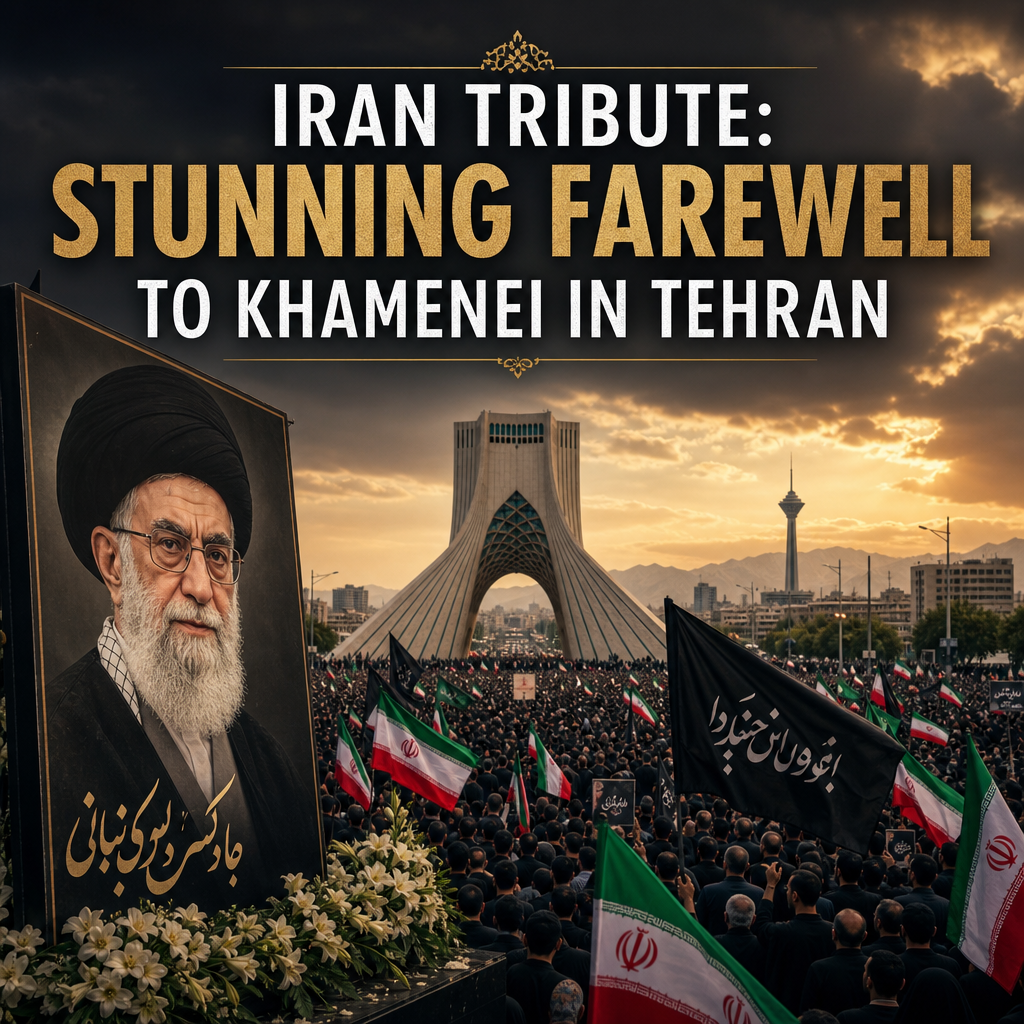
Iran tribute in Tehran became more than a state ceremony; it turned into a highly charged display of grief, political loyalty, and regional messaging, with the late Ayatollah Ali Khamenei placed at the center of a scene that carried meaning far beyond Iran’s borders.
For supporters, the farewell was presented as a moment of unity and continuity. For critics, it underscored how tightly the Islamic Republic links national identity to its ruling establishment. And for outside observers, the ceremony offered a rare glimpse into how Iran wants the world to see it: resilient, organized, and unshaken, even amid years of sanctions, regional tensions, and domestic pressure.



Iran tribute and the politics of public mourning
In Tehran, public mourning has always had a political dimension, but this farewell appeared especially layered. The ceremony was not just about honoring a national figure; it was also about reaffirming a system. In that sense, the event functioned on two levels at once: as a tribute to the dead and as a statement to the living.
Al Jazeera’s framing leaned toward the significance of the moment inside Iran and the wider region, emphasizing ceremony, symbolism, and the diplomatic optics of foreign dignitaries appearing alongside Iranian officials. That perspective matters because it highlights how carefully choreographed such events are in Tehran. Every handshake, every salute, every banner tends to carry a message about legitimacy and continuity.




RT’s coverage typically tends to stress sovereignty, resistance to Western pressure, and the idea of Iran as a state that refuses to be isolated. That angle would naturally interpret the farewell less as a fragile political ritual and more as evidence that Iran retains internal cohesion and external relevance despite long-standing attempts to weaken it.
Sky News, by contrast, usually approaches developments in Iran through a more skeptical lens, especially where power, repression, and regional risk are concerned. From that viewpoint, the spectacle would likely raise questions about how much genuine public sentiment was on display and how much was state-managed theater. That is not a trivial distinction. In authoritarian or semi-authoritarian systems, public mourning can be deeply sincere and highly directed at the same time.
The result is a picture that resists simple conclusions. The farewell may have reflected real attachment among many Iranians, especially those who view Khamenei as a foundational figure of the Islamic Republic. But it also served the state’s interests by projecting order at a time when stability is a valuable currency.
What the ceremony said to Iran
Inside the country, the message was likely aimed at several audiences:
– loyal supporters, who were reminded that the system remains intact
– skeptics, who were shown that the state can still mobilize power and symbolism
– younger Iranians, many of whom may feel detached from revolutionary narratives, but are still living within their consequences
– the political elite, for whom succession, continuity, and internal discipline remain vital concerns
That last point is especially important. In Iran, moments of transition are never just personal. They are institutional. Even a mourning ritual can be read as a signal about the resilience of the broader structure that Khamenei came to represent.
Regional reactions and the broader strategic message
The foreign dimension of the farewell may matter just as much as the domestic one. When regional and global actors pay respects in Tehran, the optics are not neutral. Their presence can suggest recognition, caution, pragmatism, or a desire to preserve channels of communication. It can also be read as tacit acknowledgment that Iran remains impossible to ignore.
That is where the sources’ differing angles become useful. Al Jazeera often pays close attention to the Middle East’s political balancing acts, and this story fits that pattern: mourning in Tehran is also diplomacy by other means. Sky News is more likely to focus on the geopolitical implications, especially if the event signals continuity in Iran’s posture toward rivals such as Israel, the United States, and neighboring Arab states. RT may frame the attendance of world figures as a rebuke to Western isolation and proof that Iran still has friends beyond the usual diplomatic circles.
What all three angles share, however, is an acknowledgment that the tribute was not happening in a vacuum. Iran’s role in the region has been defined by a combination of ideological messaging and strategic calculation. Any major ceremony involving Khamenei therefore becomes a stage on which those themes are replayed.
The deeper question is whether this kind of event changes anything. In the short term, probably not. Ceremonies do not resolve sanctions, nuclear tensions, protest movements, or regional conflicts. But they do shape perception, and perception matters in international politics. A public farewell can reinforce the impression that a state remains disciplined and emotionally mobilized, even if its society is more divided than the ceremony suggests.
Why the moment resonated
The farewell resonated because it sat at the intersection of several realities at once:
– Iran’s need to project stability
– the state’s reliance on symbolism and ritual
– regional efforts to interpret Iran’s future direction
– continuing questions about succession, legitimacy, and internal cohesion
That combination makes any reading of the event incomplete if it is too celebratory or too dismissive. The truth is probably somewhere in between. There was likely genuine grief among some mourners. There was also unmistakable political messaging. There may have been sincere respect from foreign guests. There was also strategic calculation. That complexity is what made the scene so striking.
A balanced reading of the Iran tribute suggests that it was less about a single leader than about the endurance of a political order. It reminded the world that in Iran, public ritual is never merely ceremonial. It is a language of statecraft, identity, and power. And in Tehran, even a farewell can be a form of assertion.